[Cine21 column] The medical drama doctors approve of, Doctor X: Age of the White Mafia
Cine21 examines why Doctor X’s critique of hospital hierarchies resonated with viewers—and why some doctors pushed back.
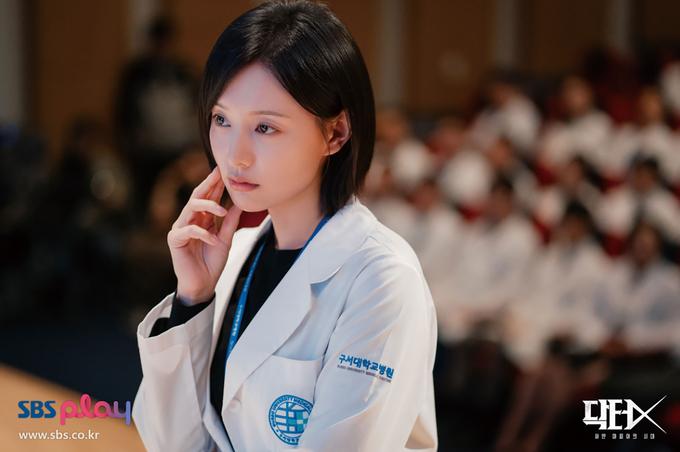
Here is a doctor who clocks out at 6 p.m. sharp every day. Gye Su-jeong (Kim Ji-won) refuses to conform to hospital customs and rarely bows to orders from her superiors. As a member of Jang Hui-suk’s (Lee Jung-eun) doctor staffing agency, the phrase she says most often is, “I don’t do that.” Rounds, staff dinners, helping professors with papers, mandatory overtime, workplace bonding—she firmly draws the line at anything unrelated to actual medical care. The phrase she says second most often is this: “And I don’t fail.” She makes decisions without hesitation, and her surgical technique is delicate and fast. Gye Su-jeong’s surgical skills are practically godlike.
That makes Doctor X: Age of the White Mafia—hereafter Doctor X—closer to a superhero story that exposes the absurdities of hospital power structures and has a genius doctor punish those responsible. But that does not mean every episode is built solely around feel-good catharsis. Medical fees, kickbacks, staff shortages, and the entrenched customs between pharmaceutical companies and the medical establishment all come into play. The drama portrays the hospital not only as a battlefield where life and death intersect, but also as an enormous workplace where different occupations and employment relationships are intertwined. While medical dramas have traditionally placed doctors’ dedication and successful surgeries front and center, the vast amount of labor that keeps those spaces running has been left out in the background. The resistance Doctor X depicts, then, is not simply about dragging down those at the top of the pyramid. It is also about changing the perspective imposed by the hierarchy itself.
For a long time, hospitals in medical dramas belonged to doctors. The people most often identified as the weakest within them were interns and residents. They suffered under senior doctors’ authority and crushing workloads, grew through the experience, and were ultimately rewarded for their hardship by becoming better doctors. Yet even when their stories criticized hospital hierarchies, they rarely ventured beyond those hierarchies. An intern will eventually become a specialist, and a resident may one day move into the very position that once oppressed them. Their suffering is generally interpreted through the prospect of generational turnover within the medical profession. Workers who clean the hospital, maintain its facilities, and sometimes have to take to the streets to collect unpaid wages are rarely offered that same story of upward mobility. They are essential to keeping the hospital running, yet they never become its representative faces. The moment a drama looks only at doctors’ labor while claiming to portray hospital labor, the inequality that structures the hospital is reduced to conflict within a single profession. And this is precisely where Gye Su-jeong looks toward those faceless people: an elderly man who supplied surgical gloves to a university hospital for over 20 years, the young niece of a worker protesting unpaid wages, a hospital cleaner, and a pharmaceutical sales representative. She looks directly into the faces of people who almost never get to be the protagonists of a story.
Gye Su-jeong even notices a contract cleaner moving slowly and senses that the cleaner may collapse. Although she cannot stand exceeding her quitting time by even 1 second, she comes in at 6:30 a.m. to check on the cleaner’s condition. Su-jeong visits patients’ rooms without her coat—so much so that even the patients are unsure whether she is a doctor—and reads the real circumstances hidden behind their apparent well-being. This is different from a heartwarming tale about a doctor who is simply kind to the vulnerable. It lays bare the reality of how the labor that keeps a hospital in order and the labor that monopolizes its prestige are assigned entirely different values. At this point, it is impossible not to mention the warm and comforting Hospital Playlist series. The doctors in that world also care deeply about the people they work with: Lee Ik-jun (Jo Jung-suk) fills in for a cafeteria worker, Ahn Jeong-won (Yoo Yeon-seok) always brings coffee for the nurses, and new doctors invite the nurses to hang out at a famous doughnut shop. Nearly all the doctors, whether major or supporting characters, are kind. But all that abundant warmth can only express a longing for an ideal community; it cannot conceal the problems hanging over reality. The structural inequality within the enormous world of a hospital is reframed as a problem arising from individual character, while the conflicts it creates are reduced to problems that a kinder person could patch up. In that sense, the medical issues Gye Su-jeong keeps prodding and stirring up, uncomfortable as they may be, are the raw reality we faced yesterday, face today, and will face tomorrow.
The problem lies outside the drama. Since Doctor X began airing, debate has continued over how the series portrays medical staff. A practicing orthopedic surgeon filed a request with the Korea Communications Standards Commission titled “Request for review of Doctor X’s distortion of medical reality and portrayal of medical professionals,” arguing, “It depicts rounds as unnecessary busywork and reduces medical staff to incompetent villains. I understand dramatic exaggeration, but it could create false impressions of medical reality.” Columns and opinion pieces have also appeared in various outlets expressing concern that the drama could cause viewers to generalize medical professionals as an incompetent and unethical group. Here, we need to distinguish between demanding accurate medical details and objecting to a work because it negatively portrays a particular profession. The moment long-standing criticism that has already emerged as a serious social issue is interpreted as an “insult” against the entire medical profession, the institutional problems targeted by the work are once again reduced to a matter of professional honor. A question about whose labor is respected inside hospitals and whose suffering is ignored is effectively answered by protests from those with the loudest voices in the medical establishment.
Above all, the catharsis Doctor X provides has one crucial thing missing: there is no Gye Su-jeong in our reality. In the drama, one doctor’s refusal to follow convention is enough to crack an enormous organization, but in real life we cannot expect a superhuman doctor to fight on behalf of patients and workers. The moment the screen goes dark, what remains is not the world Gye Su-jeong saved, but the world she took issue with. And what we see before us are the faces of doctors desperately charging in to demand that their professional honor not be tarnished. So many people have long praised Teacher Kim (Dr. Romantic), Choi Do-young (White Tower), Park Si-on (Good Doctor), Baek Kang-hyuk (The Trauma Code: Heroes on Call), and Gye Su-jeong not because the public is simply naive enough to adore kind doctors in the media, but because people want to preserve at least a shred of their dignity within hospital hierarchies and systems that have become irreversibly rigid. Unless the medical establishment can recognize the public’s deep-rooted experiences and wounds, the gap between the public and medical professionals that Doctor X has laid bare will never close.
https://cine21.com/news/view?mag_id=111128


1 comment
What's your take? Share it with other fans.
“The moment the screen goes dark, what remains is not the world Gye Su-jeong saved, but the world she took issue with.” <- This part really hits hard.